
Trump Invokes National Defense Authority to Support U.S. Energy
Energy Policy Perspectives Vol. 18 - April 29, 2026

Our views are mixed on the package of Presidential Determinations targeting five “energy areas” issued by President Trump last week. They covered: 1) grid infrastructure, equipment, and supply chain capacity; 2) development, manufacturing and deployment of large-scale energy and energy related infrastructure; 3) natural gas transmission, processing, storage and liquefied natural gas capacity; 4) domestic petroleum production, refining and logistics capacity and 5) coal supply chains and baseload power generation capacity. Broadly these memos act as the formal trigger that allows the executive branch to exercise powers already granted by Congress via Section 303 of the Defense Production Act of 1950 (DPA), specifically across the five energy areas. This creates the legal authority for the executive branch (implemented by the Secretary of Energy) to use the government as an anchor “customer” and financial backstop to support increasing the production capacity in industrial base sectors relevant to these energy areas. This is sufficient to create policy optionality but given the gaps between legally sufficient (low bar, generally not an issue) and analytically convincing, we believe its potential for initiating impactful results varies across all the targeted energy areas. See Figure 1 for a summary of our assessment of the determinations and pages 3-7 for further details on each determination.
Three core claims. Across all five determinations, three core claims are made across the targeted areas: 1) they are essential to national defense; 2) without presidential action, industry cannot sufficiently provide these capabilities in a timely manner; and 3) Section 303 is the most cost-effective, expedient and practical alternative method to expand and develop domestic capacity. Critically, these claims can be simply asserted rather than having to be proven due to a waiver explicitly allowed in the statute in the event of a national emergency, which President Trump declared in his January 20, 2025 executive order (EO) 14156 “Declaring a National Energy Emergency”. This waiver also removes other statutory guardrails which improve the speed of policy action, while reducing accountability. This is an expansive application of established precedent making it relatively durable judicially but remains politically vulnerable once the current administration leaves office (closed transactions would remain valid).

Limitations of DPA tools. All five determinations establish policy intent and the potential for the federal government to provide financial support but there are significant limitations to what these determinations alone can achieve, in our opinion. Section 303 of the DPA was designed to address specific and narrow market failures where defense-essential industrial capability exists but cannot be expanded because private capital is unwilling to fund it due to demand uncertainty or financing constraints. This makes DPA financial instruments alone structurally insufficient as a primary policy intervention tool across most of the sub-sectors, in our view. Purchase commitments for capacity expansion of nuclear pressure vessels and forging, advance purchase commitments to break pre-FID LNG project liquefaction equipment timing mismatches, and loan guarantees/purchase commitments to bridge first-of-a-kind financing gaps for emerging energy technologies are some of the most directly relevant use cases. In many cases the market is functioning rationally, on the basis of profit-seeking but not necessarily national defense, and government financing alone cannot accelerate the rate of capacity expansion. DPA tools can be partially useful when financing is a secondary bottleneck but several use cases are not constrained by financing directly or economics are structurally unfavorable in a way that a subsidy cannot remedy.
No silver bullet. We attempt to analyze each area critically, not legally, where the bar is much lower, by assessing if it is essential to critical defense, whether the industry has a scaling problem and the relative fit of DPA financial tools, while acknowledging their limitations and that no policy action is a silver bullet. Due to the waivers, project selection is discretionary and there are no statutory requirements for a competitive application, cost-effectiveness review, or congressional oversight. It is ultimately at the discretion of the Energy Secretary which projects and areas actually get financial support, with key constraints being funding and institutional capacity to structure deals. It is important to recognize that this is one policy tool in the administration’s tool kit and that many of the energy sectors issues are deep, technically complex and require much broader coordination and planning to adequately address.
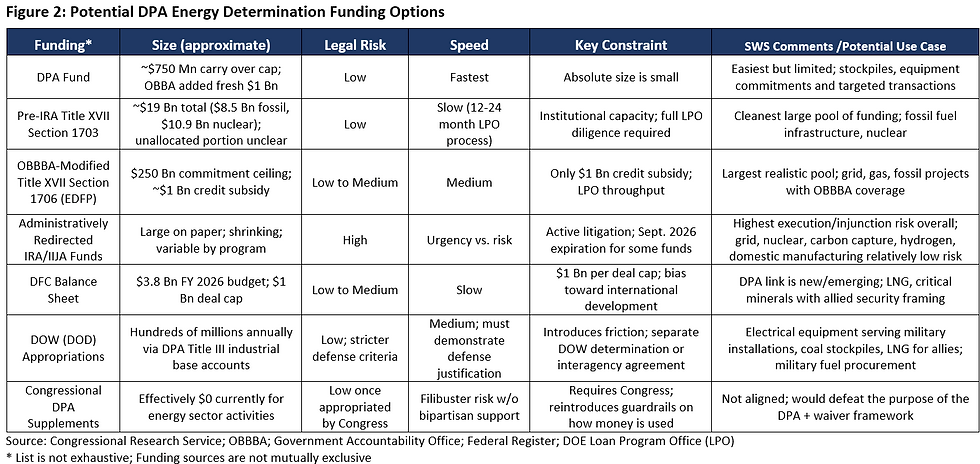
Missing money. The memos create the legal authority for the Secretary of Energy to write checks for the relevant areas on the basis of national defense, with normal checks and balances waived, but on their own they do not appropriate new money to support this. Therefore, available appropriations are the major constraint and what will likely dictate how much money actually flows under these DPA determinations, ironic given financing constraints are one of the justifications for these actions. Every dollar requires a separate, pre-existing funding source, see Figure 2 for a summary of some potential funding sources.
Grid infrastructure, equipment & supply chain. The most analytically defensible of the determinations, in our opinion, with genuine pre-existing domestic market supply failures, documented existing supply chain vulnerabilities, and alignment with DPA purchase commitments and manufacturing capacity investment. It frames limited domestic equipment manufacturing capacity and import dependence, particularly on adversary-adjacent supply chains, as a core defense vulnerability. Some of its weaknesses include the tariff contradiction on inputs (i.e. steel tariff raises cost to develop domestic GOES), the omission of 303(e) equipment installation authority as a more precise tool to expand manufacturing capacity, and its focus almost entirely on moving power (transmission/distribution). It does not address generation equipment (which potentially falls under the broad large-scale energy determination), one of the most acute near-term and obvious grid equipment bottlenecks. Permitting and interconnection queue delays remain a primary and secondary bottleneck that are not addressable by financial instruments, so parallel policy actions would more significantly impact the effectiveness of any of these DPA solutions. Numerous federal actions are underway on this front (NEPA and FERC reform) but binding constraints, especially for transmission deployment, often are at the state (citing authority and environmental review) and local (zoning, private landowner right-of-way) levels. However, FERC is concurrently implementing new policy that is reducing allowed regulatory ROEs, dramatically reducing the economic motivations for new large scale transmission project development that had proven effective over the past few decades, and eliminating much of the ROE advantage of transmission investments relative to alternative uses of limited capital.
Time to market. While at least some of the motivations of the determination memos could provide beneficial results in limited areas, the big questions regarding the intent of the memos surround timing and effectiveness. With nearly a quarter of a trillion dollars of domestic utility capital expenditure annually, funding does not appear to be the primary issue. Tariff tools, domestic content law and/or other policy options and incentives could help shift market economics so that existing capital is potentially re-directed toward re-shoring domestic manufacturing capacity. Also, policy changes previously utilized such as transmission ROE incentives may have broader, more permanent bipartisan support than the potential ~2-year shelf life of the DPA determination. The long lead time of establishing new domestic grid equipment manufacturing, even with effective DPA support, likely pushes any tangible memo market initiatives out a number of years. The political support may not remain long enough to see actual results whereas market-based solutions such as domestic content legislation or ROE policy may prove more durable beyond the current administration and Congressional composition.

Large-scale energy & energy-related infrastructure. The most analytically mixed determination given its broad policy scope, which is both its greatest strength and weakness, in our view. We believe domestic manufacturing capacity for energy equipment is a genuine and well-documented bottleneck with a relatively strong DPA tool fit. “Enabling infrastructure” is vague enough to have legal strength but difficult to analyze analytically. The determination combines support for equipment-based bottlenecks with project development stages which are not directly addressable by financial instruments and creates some awkwardness. Permitting and site acquisition constraints are jurisdictional and political in nature and designating a financing mechanism (early-stage risk mitigation financing) as defense-essential is a bit circular in this context. Nuclear and advanced geothermal, though not explicitly mentioned, seem logically and strategically coherent beneficiaries of this determination. This determination’s lack of specificity could also provide the authority to interpret it in a way that it could be used to address gas turbine shortages as well as future emerging shortages tied to domestic manufacturing capacity. The non-physical areas we think are analytically stretched and not directly addressable by financial tools. Improving domestic manufacturing capacity is important, particularly for long-term scalability and supply chain resiliency but regulatory reform around permitting, environmental reviews and interconnection are often the binding constraints preventing and delaying large energy projects and infrastructure from being built.

Natural gas transmission, processing, storage and LNG. The constrained growth seen across the majority of the natural gas industry is driven by rational capital discipline shaped by historical boom-bust cycles that destroyed capital, not a financing market failure requiring government intervention. Producers, lenders and investors have deliberately slowed growth investment not because capital is unavailable but because long-dated commodity price risk makes returns unacceptable without demand certainty, a problem DPA offtake commitment can partially address for specific use cases but cannot resolve across the broader sector. The strongest applications are equipment-based bottlenecks: long-lead liquefaction train components (heat exchangers, cold boxes, large centrifugal compressors running multi-year lead times), gas processing equipment (cryogenic units, molecular sieves), and compression for gathering, transmission, and processing facilities (extended lead times from a concentrated supplier base). For these, DPA advance purchase commitments directly address the timing mismatch between equipment ordering and project financing and can help scale domestic capacity. The allied security framing stretches the DPA’s national defense language into geopolitical security, risk of hostile-state energy dependence, but this has legal precedent. Pipeline constraints are primarily jurisdictional (FERC permitting, rights-of-way, state opposition) and underground storage suffers primarily from regional geologic constraints rather than a national shortage. LNG export facilities more broadly, not just the liquefaction trains, suffer primarily from regulatory and jurisdictional issues.

Domestic petroleum production, refining & logistics. This determination covers exploration and production, gathering and transmission pipelines, petroleum storage, and marine terminals. It frames domestic petroleum capacity as central to military readiness, industrial base operation, and critical infrastructure, citing vulnerability to supply disruption as the defense rationale. E&Ps are already operating at or near peak efficiency, delivering record production levels without the need for incremental Federal support. The sector remains focused on capital discipline, prioritizing free cash flow and shareholder returns over production growth, especially given the backwardated oil curve, which disincentivizes long-term investment. There are no financing constraints for the sector. On the surface refining capacity has a substantial growth issue with the last major greenfield refinery built in 1977 (Trump announced new $300 billion project on March 10th) and rising utilization rates but this is not inherently a financing issue, rather rational capital discipline due to unattractive long run economics over the ~30-year life of the investment when demand is expected to decline from fuel efficiency improvements and EV adoption. Oil pipelines, similar to natural gas pipelines are primarily constrained by jurisdictional and legal battles. Storage and logistics resilience investments are the only sub-sector we believe fits the DPA tools; however, the relatively small scale dampens its impact potential.

Coal supply chains & baseload power generation. We believe this is the weakest of the five determinations analytically. The memo attempts to use the importance of operational characteristics like firm capacity (guaranteed availability when needed) and dispatchability (ability to increase or decrease output on demand) as justification for coal. These characteristics are not unique to coal and coal’s usage has been in a structural decline for ~20 years because better alternatives exist to provide these characteristics. The only “unique value” coal has is that existing coal plants are installed sunk capital that can continue operating, value that markets have increasingly begun to appreciate (2.6 GW retired in 2025, a 15-year low, vs. 8.5 GW planned at beginning of 2025 per Form EIA-860 data) as permitting timelines, interconnection queue backlogs, transmission congestion and supply chain constraints have delayed the capacity that was supposed to replace the retiring capacity. In that framing, federal financial support for life-extension of specific coal plants to act as a bridge until replacements come online has a defensible reliability rationale that is separable from coal's long-run economics [covered under 202(c) Federal Power Act that the administration has issued over 40 times since May 2025; currently keeping ~4.4GW across 6 coal plants online]. This is very different from the claim made in the memo that “coal is irreplaceable and essential” and attempts to support the entire supply chain. The two sub sectors that somewhat fit DPA analytically (rail & barge logistics and on-site fuel stockpiles) are narrow, operationally modest and already addressable through numerous existing non-DPA mechanisms. Mining and export terminals both are analytically weak justifications.

PLEASE SEE BELOW FOR IMPORTANT DISCLOSURES, REG AC ANALYST CERTIFICATION AND DISCLAIMERS
Siebert Williams Shank & Co., LLC or its Affiliates do and seek too business with companies covered in its research reports. As a result, investors should be aware that the firm may have a conflict of interest that could affect the objectivity of this report. Investors should consider this report as only a single factor in making their investment decision.
Analyst Certification
We, Christopher R. Ellinghaus and Gabriele Sorbara hereby certify that the views expressed in this research report accurately reflect our personal views about the subject companies and their securities. We further certify that no part of our compensation was, is, or will be directly, or indirectly, related to the specific recommendations or views contained in this research report.
Financial Interests: Neither we, Christopher R. Ellinghaus or Gabriele Sorbara, nor any member of our households own securities in any of the subject companies mentioned in this research report. Neither we, nor a member of our households is an officer, director, or advisory board member of the subject company or has another significant affiliation with the subject company. We do not know or have reason to know at the time of this publication of any other material conflict of interest.
Analyst Compensation: The authors compensation is based upon the value attributed to research services by Siebert Williams Shank institutional brokerage clients. The authors of this report are compensated based on the performance of the firm, and have not received any compensation in the past 12 months from any of the subject companies mentioned in this report. The performance of the firm is driven by its secondary trading revenues, investment banking revenues, and asset management revenues.
Siebert Williams Shank Equity Research Ratings Key
BUY: In the analyst's opinion, the stock will outperform the S&P 500 on a total return basis over the next 12 months.
HOLD: In the analyst's opinion, the stock will perform in line with the S&P 500 on a total return basis over the next 12 months.
SELL: In the analyst's opinion, the stock will underperform the S&P 500 on a total return basis over the next 12 months.
Distribution of Equity Research Ratings as of: April 28, 2026

IBC (Investment Banking Clients) is defined as companies in respect of which Siebert Williams Shank (the “firm”) or its affiliates have received or are entitled to receive compensation for investment banking services in connection with transactions that were publicly announced in the past 12 months.
Other Important Disclosures
Investment Banking Disclosures: Within the past 12 months, the research analyst authoring this report has not participated in a solicitation of any subject company mentioned within this report, with or at the request of investment bankers, for investment banking business. Within the past 12 months, the firm and its affiliates have not managed or co-managed a public offering of the securities of any subject company mentioned within this report, nor has the firm received compensation for investment banking products or services from those companies.
Firm Compensation: Within the past 12 months, the firm and its affiliates have not received compensation for any non-investment banking products or services for subject companies mentioned in this report, and none of these subject companies have been a client of the firm during the past 12 months.
Stock Ownership: The firm and its affiliates do not own 1% or more of any class of equity security in this report, and do not make a market in any such securities.
Disclaimers: The information and opinions contained in this report were prepared by the firm and have been derived from sources believed to be reliable, but no representation or warranty, expressed or implied, can be made as to their accuracy. All opinions expressed herein are subject to change without notice. This report is for information purposes only and should not be construed as an offer to buy or sell any securities. The firm makes every effort to use valuation methodologies that it believes to be reasonable in the derivation of price targets, but we do not guarantee that such methodologies are accurate.
Additional Information: To receive any additional information upon which this report is based, please contact:
Siebert Williams Shank, Research Department
100 Wall Street, 18th Floor New York, NY 10015
212-830-4500


